วันพุธที่ 12 ธันวาคม พ.ศ. 2550

มาเรียนเรื่อง interrogative กันเถอะ !

หวัดดีจ้าเพื่อนๆ^O^ วันนี้มาพร้อมสาระ(จริงๆนะ+O+)ที่สามารถนำไปใช้ในบทเรียนของเราได้ ซึ่งเนื้อหาเหล่านี้อาจจะทำให้ใครหลายคนคงเข้าใจได้ไม่มากก็น้อย บรรยายมาเยอะแล้ว มาเข้าเรื่องกันดีกว่านะจ๊ะ ^o^//

An interrogative construction is a grammatical form used to ask a question. There are two kinds of questions: yes/no questions and information questions. So-called yes/no questions may be answered with a simple 'yes' or 'no'.
Are you a student at the University of Texas?
Have you ever been to Sixth Street or Barton Springs?
Do you know how many Aggies it takes to screw in a lightbulb?

Information questions contain a specific interrogative word (who, what, when, why, how) and cannot be answered with a yes or no. Their purpose is to elicit a specific piece of information.
Who is Tex?
When did he come to Texas?
How did he learn French?


Est-ce que vous parlez français?
Do you speak French?
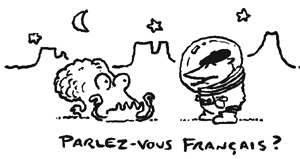
Besides using 'est-ce que', questions in French can be formed by inversion of the subject and verb.
Parlez-vous français?
Do you speak French?


formulating questions The word 'do' is used in English question formation. In similar fashion, French yes / no questions can be formed with the phrase est-ce que.

There are several other ways to ask a question in French. For instance, a tag question is a question word or phrase 'tagged' on to the end of a statement which requires a confirmation with a 'yes' or 'no' answer.
Vous parlez français, n'est-ce pas?
You speak French, don't you?

Finally, the most common way to ask a question in French conversation is to use rising intonation. In this kind of interrogative construction, the word order is the same as a declarative sentence, but the speaker's voice rises at the end to signal the question.
Vous parlez français?
You speak French?


CrediT bY:laits.utexas.edu/tex/

วันจันทร์ที่ 3 ธันวาคม พ.ศ. 2550

Fruit Salad

อัลโล^O^ หายไปนานเลย คิดถึงกันใช่ไหม>O< วันนี้มาเข้าเรื่องดีๆมีสาระกันดีกว่านะ
ผลไม้เพื่อสุขภาพค่ะ ขนมหวานจานหลักของบ้านลูกไก่ค่ะ จะใช้ผลไม้ตามฤดูเพื่อความประหยัดค่ะ ไม่ได้ radin นะคะแต่ économe มากกว่า

radin = ขี้เหนียว

écomome = มัธยัสถ์

ผลไม้็ก็มี แอปเปิล กล้วย องุ่นดำ แอปปริคอต แตงโม และ เนคทารีน ซึ่งรูปร่างหน้าตาคล้ายๆ ลูกพีช แต่มีสีแดง เข้มกว่า อร่อยกว่าด้วย
วิธีทำ
หั่นผลไม้ทุกอย่างเป็นชิ้นเล็กๆ เติมน้ำส้มสดลงไป 1 แก้ว จะใช้น้ำส้มคั้นสดๆ หรือ น้ำส้มกล่องสดที่มีขายในช่องแช่เย็นตามซุปเปอร์มาร์เก็ตก็ได้ ลูกไก่ใช้อย่างหลังเพราะสะดวกดี กล้วยกับแอปเปิลหั่นแล้วต้องรีบราดน้ำส้มเลยนะคะ ไม่งั้นดำหมดไม่น่าทานค่ะสูตรลูกไก่ไม่ได้เติมน้ำตาลหรือน้ำเชื่อมอะไรหรอกนะคะ รสธรรมชาติจริงๆ

CREDIT BY: Bloggang de P' Lukkai

วันศุกร์ที่ 9 พฤศจิกายน พ.ศ. 2550

VISA !ออกเดินทาง ^O^

อ้า...^O^วันนี้มีความรู้ทั่วไปเกี่ยวกับวีซ่าเพื่อจะเดินทางไปฝรั่งเศสมาฝากพี่น้องกันคับ !
วีซ่าเพื่อศึกษาต่อ
กรอกคำร้องขอวีซ่าระยะยาว 2 ชุดรูปถ่ายปัจจุบันของผู้ยื่นคำร้อง 2 รูป ขนาด 3.5 x 4.5 ซ.ม. บนพื้นขาว หนังสือเดินทางที่มีอายุใช้การเกินกว่า 1 ปี สำเนาบัตรประชาชน สูติบัตร หลักฐานแสดงการสำเร็จการศึกษา หนังสือรับรองการลงทะเบียนในมหาวิทยาลัยหรือหนังสือรับรองการเข้าอบรมในประเทศฝรั่งเศส หนังสือรับรองทางการเงิน ผู้ได้รับทุน จะต้องแนบหนังสือรับรองที่ระบุจำนวนเงินทุนและระยะเวลาที่ได้รับทุน สำหรับบุคคลทั่วไป จะต้องแนบหนังสือรับรองที่ระบุจำนวนเงินที่จะได้รับอย่างต่ำ 5,124 ยูโรหรือ 210,000 บาทต่อปีการศึกษา หรือหนังสือรับรองการโอนเงินเข้าบัญชีธนาคารอย่างต่ำเดือนละ 427 ยูโรหรือ 17,500 บาท หนังสือรับรองที่พัก อาจเป็น- ใบรับรองที่พักจากผู้ให้ที่พักพิงในประเทศฝรั่งเศสพร้อมสำเนาบัตรประจำตัวประชาชน - สัญญาการเช่าที่พัก- ทะเบียนบ้านในประเทศฝรั่งเศส - ใบรับรองการจองห้องพักในหอพักของมหาวิทยาลัย สำหรับผู้ได้รับทุนจากรัฐบาลฝรั่งเศสจะต้องแนบใบรับรองการตรวจร่างกายจากแพทย์ซึ่งได้รับการรับรองจากสถานทูตฝรั่งเศส ผู้ที่ยังไม่บรรลุนิติภาวะจะต้องแนบใบรับรองการยินยอมจากผู้ปกครอง ค่าธรรมเนียม 50 ยูโร
วีซ่าเยี่ยมญาติ
1. กรอกคำร้องขอวีซ่าระยะสั้น 1 ชุด 2. รูปถ่าย 2 รูป ขนาด 3.5 x 4.5 ซ.ม. บนพื้นขาว 3. หนังสือเดินทางที่มีอายุใช้การเกินกว่า 6 เดือน 4. สำเนาบัตรประชาชน 5. หลักฐานส่วนตัวของผู้รับรองในประเทศฝรั่งเศส ซึ่งมี- หนังสือรับรองที่พัก - หนังสือรับรองการทำงานและรับรองเงินเดือนของผู้รับรองในประเทศฝรั่งเศส (เฉพาะในกรณีที่หลักฐานดังกล่าวของผู้เดินทางไม่สมบูรณ์) -หนังสือรับรองเงินเดือน 3 เดือนสุดท้าย -หลักฐานการจ่ายภาษีเงินได้งวดสุดท้าย- จดหมายรับรองแสดงความประสงค์ที่จะรับผิดชอบต่อผู้เดินทางพร้อมระบุวัตถุประสงค์ของการเดินทาง- สำเนาบัตรประจำตัวประชาชนหรือสำเนาหนังสือเดินทางของผู้รับรอง เหมือนวีซ่าส่วนตัวเพิ่ม หลักฐานแสดงความสัมพันธ์ทางครอบครัว (หนังสือครอบครัว ใบสูติบัตร ฯลฯ)
วีซ่าประเภทเดินทางส่วนตัว
1. กรอกคำร้องขอวีซ่าระยะสั้น 1 ชุด 2. รูปถ่าย 2 รูป ขนาด 3.5 x 4.5 ซ.ม. บนพื้นขาว 3. หนังสือเดินทางที่มีอายุใช้การเกินกว่า 6 เดือน 4. สำเนาบัตรประชาชน เหมือนวีซ่าท่องเที่ยวแต่เพิ่มหลักฐานส่วนตัวของผู้รับรองในประเทศฝรั่งเศส ซึ่งมี- หนังสือรับรองที่พัก - หนังสือรับรองการทำงานและรับรองเงินเดือนของผู้รับรองในประเทศฝรั่งเศส (เฉพาะในกรณีที่หลักฐานดังกล่าวของผู้เดินทางไม่สมบูรณ์) -หนังสือรับรองเงินเดือน 3 เดือนสุดท้าย -หลักฐานการจ่ายภาษีเงินได้งวดสุดท้าย- จดหมายรับรองแสดงความประสงค์ที่จะรับผิดชอบต่อผู้เดินทางพร้อมระบุวัตถุประสงค์ของการเดินทาง- สำเนาบัตรประจำตัวประชาชน


Credit by : Bloggang [P' lukkai]

วันพุธที่ 7 พฤศจิกายน พ.ศ. 2550

ไม่ ไม่ ไม่ !

มาแล้วนะ วันนี้มาพร้อมกับสาระดีๆเช่นเคย จะไม่พูดพร่ำทำเพลง เข้าเรื่องกันเล้ย...
Negation is a grammatical term for the contradiction of some or all of the meaning of an affirmative (positive) sentence. In English, a sentence is commonly negated by inserting a single negative word (not, don't, didn't, won't , etc.) into the appropriate place in the sentence. In French, a sentence is commonly negated by inserting two words.
basic negation
Ne ... pas is placed around the conjugated verb to negate an affirmative sentence in French. Note that the ne changes to n' before a verb beginning with a vowel.

Joe-Bob, l'écureuil, court vite.
Joe-Bob, the squirrel, runs fast.
Edouard, l'escargot, ne court pas vite.
Edouard the snail doesn't run fast.
Trey aime le rap.
Trey likes rap.
Joe-Bob n'aime pas le rap.
Joe-Bob doesn't like rap.

alternate forms of negation
There are many other French words that one can use to negate a positive statement besides the basic form ne ... pas. Moreover, negative words can be used to contradict the verb as well as other parts of the original affirmative sentence.

Joe-Bob écoute de la musique country.
Joe-Bob listens to country.
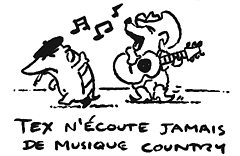
Tex n'écoute jamais de musique country.
Tex never listens to country.
Trey n'écoute que du rap.
Trey only listens to rap.
Fiona n'écoute rien.
Fiona listens to nothing.
Presque persone n'écoute de musique country en France.
Almost nobody listens to country music in France.

Credit by : laits.utexas.edu/tex/

วันอังคารที่ 6 พฤศจิกายน พ.ศ. 2550

Up Up ! มาอัพแล้ว

หวัดดีทุกคน^O^ กว่าจะได้อัพยากเย็นเหลือเกิน เน็ตที่บ้านช้ามากๆ ไม่ได้อัพตั้งเดือนหนึ่ง ต้องขอโทษด้วยที่อัพช้าขนาดนี้ ตอนนี้อัพที่โรงเรียนอยู่ อ่ะๆ...เข้าเรื่องกันดีกว่านะ มีสาระดีๆของภาษาฝรั่งเศสมาฝากกันด้วย >O<
Verbs like prendre are conjugated like regular -re verbs in the singular, but not in the plural. Note the difference in the stem in the plural forms.

prendre 'to take'
je prends
tu prends
il/elle/on prend
nous prenons
vous prenez
ils/elles prennent
past participle: pris

Verbs conjugated like prendre include:
apprendre, to learn
comprendre, to understand
surprendre, to surprise


Edouard et Tammy surprennent Tex.
Edouard and Tammy surprise Tex.
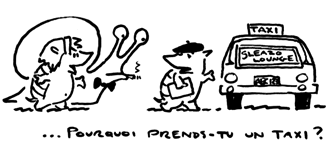
Tammy: Qu'est-ce que tu fais, Tex? Tu vas où? Pourquoi tu prends un taxi?
Tammy: What are you doing, Tex? Where are you going? Why are you taking a taxi?
Tex: Uhh, je suis en retard. Uhh, je vais en classe. Aujourd'hui mes étudiants apprennent à chanter la Marseillaise!
Tex: Uhh, I'm late. Uhh, I'm going to class. Today my students are learning to sing the Marseillaise!


Credit by: laits.utexas.edu