วันศุกร์ที่ 4 มกราคม พ.ศ. 2551

EN

อ้า...หวัดดีจ้าทุกคน กลับมาพร้อมสาระดีๆที่มีมาเสมอ(โอ้ว...มาเป็นสโลแกน) เราอย่าพูดพร่ำทำเพลง มาเข้าเรื่องกัยเลย
En is a pronoun that typically replaces de + a noun; this includes nouns introduced by partitive or indefinite determiners (de, du, de l', de la, des). En may be translated as 'some', 'any', or 'not any'.
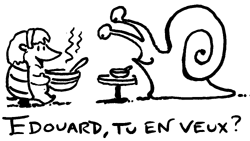
Tammy, Edouard et Tex sont à table.
Tammy, Edouard and Tex are eating.
Tammy: Edouard, tu veux de la soupe?
Tammy: Edouard, do you want some soup?
Edouard: Oui, merci. Elle est délicieuse.
Edouard: Yes, thank you. It is delicious.
Tex: Il y a du vin?
Tex: Is there any wine?
Tammy: Oui il y en a. Tu en veux?
Tammy: Yes, there is some. Would you like some?

In a similar fashion, en replaces a noun introduced by a number or an expression of quantity. Notice that the equivalent of en is not always expressed in English, although en must still be used in the French sentence:
Tammy: Edouard, tu as assez de pain?
Tammy: Edouard, do you have enough bread?
Edouard: Oui, merci, j'en ai assez.
Edouard: Yes, thank you, I have enough (of it).
Tammy: Tex, tu veux un peu de pain?
Tammy: Tex, do you want a little bread?
Tex: Non, merci, je n'en veux pas. J'en ai encore une tranche.
Tex: No, thank you, I do not want any. I still have a slice (of it).

En also replaces expressions introduced by the preposition de with the following verbs:
s'occuper de, to deal with
parler de, to speak of
remercier de, to thank for
revenir de, to return from
venir de, to come from


Tammy: Alors Edouard, comment s'est passée ton interview au restaurant?
Tammy: So Edouard, how did your interview at the restaurant go?
Edouard: J'en reviens tout juste! C'était dégoûtant.
Edouard: I've just returned from it! It was disgusting.
Tammy: Tu veux en parler?
Tammy: Do you want to talk about it?
Edouard: Tu sais bien que j'ai envie de gagner plus d'argent, j'en ai vraiment besoin, mais servir du barbecue! Jamais! Edouard ne travaillera jamais dans un restaurant qui s'appelle le Bon Barbecue!
Edouard: You know that I want to earn more money. I really need some (money), but serve barbecue! Never! Edouard will never work in a restaurant named Good Barbecue!
Note that a disjunctive pronoun is used with these verbs to replace expressions when the object of the prepostion de is a person rather than a thing.

CREDIT BY: laits.utexas.edu/tex
วันศุกร์ที่ 21 ธันวาคม พ.ศ. 2550

เรื่องของอดีต

วันนี้เรียนสนุกดี^o^ ตอนนี้การเรียนเป็นส่วนหนึ่งของชีวิตไปแล้วโดยปริยาย เดี๋ยวแป๊บเดียวเองก็จะขึ้น ม.6 แล้ว (แก่ไป 1ปี) แล้วก็ต้องเตรียมแอดอีก เฮ้อ...ถึงตอนนั้นคงเหนื่อยสุดๆเลย แต่ก็สู้ๆสู้ตายค้า...>O<"
The imperfect tense (l'imparfait) has two primary uses: to describe on-going actions and states of being in the past, and to state habitual actions in the past. The imparfait also has several idiomatic uses. The passé composé and imparfait are each used quite differently in narration.
states of being or past description
The imparfait is used to describe people, places, conditions or situations in the past. Some verbs occur more frequently in the imparfait when they are in the past since they typically describe states of being: être, avoir, vouloir, pouvoir. But these verbs do sometimes occur in the passé composé.
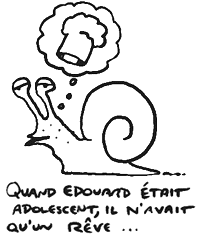
Quand Edouard était adolescent, il n'avait qu'un rêve – devenir un grand cuisinier. Il voulait créer des chefs-d'oeuvre culinaires. Notre jeune escargot gourmand, qui adorait la cuisine française classique, fréquentait les meilleures tables de Paris.
When Edouard was a teenager, he had only one dream – to become a great chef. He wanted to create culinary masterpieces. Our young food-enthusiast snail, who loved classical French cooking, frequented the best Parisian restaurants.
habitual actions in the past
The imparfait is also used to state habitual actions in the past. These past habits are often translated as 'used to, or 'would.' Distinguish between the use of 'would' for habitual past actions (imparfait) and the use of 'would' for the conditional. Note that the imparfait may also be translated by the simple past in English; however, the context, and often adverbs, let you know the action is a past habit.
Edouard: Tu te rappelles, en été à Paris, quand il faisait chaud? On allait toujours à 10 heures du soir chez Berthillon ... Oh, là, là, leurs glaces, leurs sorbets--fraise, framboise, noisette, pistache, des parfums exotiques. Et puis, on se promenait le long des quais, on voyait la Seine qui coulait, on chantait, on se récitait même des vers. Ah, Paris la nuit, Paris là-bas, mmm, en été.
Edouard: Do you remember, in the summer in Paris, when the weather was hot? We always used to go to Berthillon's at 10 o'clock in the evening ... Oh, la, la, their ice cream, their sorbets--strawberry, raspberry, hazelnut, pistachio, exotic flavors. And then, we would take walks along the quays. We would see the Seine which was flowing. We would sing, we would even recite verses. Ah, Paris in the night, Paris over there, mmm, in the summer.

CREDIT BY:laits.utexas.edu/tex

วันพุธที่ 19 ธันวาคม พ.ศ. 2550

A preposition เรื่องง่ายๆ สบายๆ

Tomtam Fine and Dear

หวัดดีจ้า^O^ กลับมาพร้อมความสดใส น่ารัก(อ่ะเปล่าไม่รู้)แต่ที่รู้ๆคือเรามีสาระความรู้มาฝากกันเสมอ วันนี้ก็เช่นกัน เรามาเริ่มเรียนกันเล้ย...>O<"

A preposition is a word used to establish relationships between nouns, between nouns and verbs and between different parts of a sentence. Prepositions usually have spatial or temporal meanings (e.g. beneath, between, in front of, before, after, during, etc). Prepositions are invariable, that is, they have one form with the exception of à and de which contract with the definite articles (le, la, les).

Translating prepositions is notoriously tricky. Never assume that French will use the same preposition as English to express a particular meaning. In fact, there are many cases where one language requires a preposition where the other does not. This is particularly problematic with infinitives followed by prepositions. In general, it is best to treat prepositions as vocabulary items requiring memorization.

In the following sentences, these problems are demonstrated by translating the French prepositions literally. Note how awkward the English translation is as a result.
Bette est fâchée contre Tammy.
Bette is angry against Tammy.Bette is angry at Tammy.
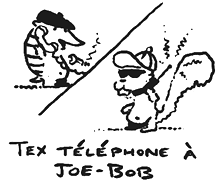
Tex téléphone à Joe-Bob.
Tex telephones to Joe-Bob.
Tex telephones Joe-Bob.


Literal translations are also awkward in situations where a preposition is not used in French but is required in English.
Fiona attend le bus.
Fiona waits the bus.Fiona waits for the bus.
Joe-Bob écoute la radio.
Joe-Bob listens the radio.Joe-Bob listens to the radio.


CReDiT bY:laits.utexas.edu/tex

วันพุธที่ 12 ธันวาคม พ.ศ. 2550

มาเรียนเรื่อง interrogative กันเถอะ !

หวัดดีจ้าเพื่อนๆ^O^ วันนี้มาพร้อมสาระ(จริงๆนะ+O+)ที่สามารถนำไปใช้ในบทเรียนของเราได้ ซึ่งเนื้อหาเหล่านี้อาจจะทำให้ใครหลายคนคงเข้าใจได้ไม่มากก็น้อย บรรยายมาเยอะแล้ว มาเข้าเรื่องกันดีกว่านะจ๊ะ ^o^//

An interrogative construction is a grammatical form used to ask a question. There are two kinds of questions: yes/no questions and information questions. So-called yes/no questions may be answered with a simple 'yes' or 'no'.
Are you a student at the University of Texas?
Have you ever been to Sixth Street or Barton Springs?
Do you know how many Aggies it takes to screw in a lightbulb?

Information questions contain a specific interrogative word (who, what, when, why, how) and cannot be answered with a yes or no. Their purpose is to elicit a specific piece of information.
Who is Tex?
When did he come to Texas?
How did he learn French?


Est-ce que vous parlez français?
Do you speak French?

Besides using 'est-ce que', questions in French can be formed by inversion of the subject and verb.
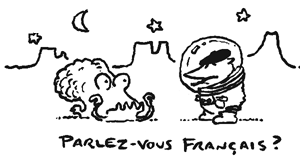
Parlez-vous français?
Do you speak French?


formulating questions The word 'do' is used in English question formation. In similar fashion, French yes / no questions can be formed with the phrase est-ce que.

There are several other ways to ask a question in French. For instance, a tag question is a question word or phrase 'tagged' on to the end of a statement which requires a confirmation with a 'yes' or 'no' answer.
Vous parlez français, n'est-ce pas?
You speak French, don't you?

Finally, the most common way to ask a question in French conversation is to use rising intonation. In this kind of interrogative construction, the word order is the same as a declarative sentence, but the speaker's voice rises at the end to signal the question.
Vous parlez français?
You speak French?


CrediT bY:laits.utexas.edu/tex/

วันจันทร์ที่ 3 ธันวาคม พ.ศ. 2550

Fruit Salad

อัลโล^O^ หายไปนานเลย คิดถึงกันใช่ไหม>O< วันนี้มาเข้าเรื่องดีๆมีสาระกันดีกว่านะ
ผลไม้เพื่อสุขภาพค่ะ ขนมหวานจานหลักของบ้านลูกไก่ค่ะ จะใช้ผลไม้ตามฤดูเพื่อความประหยัดค่ะ ไม่ได้ radin นะคะแต่ économe มากกว่า

radin = ขี้เหนียว

écomome = มัธยัสถ์

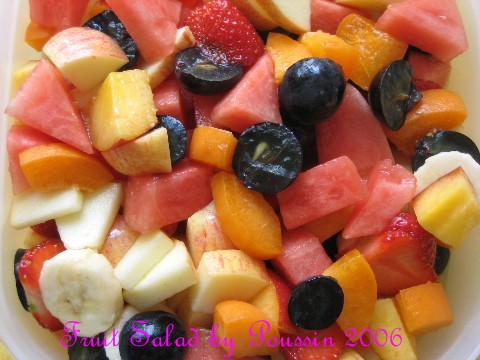
ผลไม้็ก็มี แอปเปิล กล้วย องุ่นดำ แอปปริคอต แตงโม และ เนคทารีน ซึ่งรูปร่างหน้าตาคล้ายๆ ลูกพีช แต่มีสีแดง เข้มกว่า อร่อยกว่าด้วย
วิธีทำ
หั่นผลไม้ทุกอย่างเป็นชิ้นเล็กๆ เติมน้ำส้มสดลงไป 1 แก้ว จะใช้น้ำส้มคั้นสดๆ หรือ น้ำส้มกล่องสดที่มีขายในช่องแช่เย็นตามซุปเปอร์มาร์เก็ตก็ได้ ลูกไก่ใช้อย่างหลังเพราะสะดวกดี กล้วยกับแอปเปิลหั่นแล้วต้องรีบราดน้ำส้มเลยนะคะ ไม่งั้นดำหมดไม่น่าทานค่ะสูตรลูกไก่ไม่ได้เติมน้ำตาลหรือน้ำเชื่อมอะไรหรอกนะคะ รสธรรมชาติจริงๆ

CREDIT BY: Bloggang de P' Lukkai